Visual Computing Systems ยท MobiCom 2023

Squint: A Framework for Dynamic Voltage Scaling of Image Sensors Towards Low Power IoT Vision

Authors
Venkatesh Kodukula, Mason Manetta, Robert LiKamWa
Venue
MobiCom 2023 - The 29th International Conference on Mobile Computing and Networking

Squint makes sensor voltage a first-class control in the visual pipeline, enabling IoT vision systems to reduce analog readout power according to the fidelity needs of the task.

Introduction: Rethinking Fixed-Voltage Imaging

Modern image sensors consume substantial power through analog readout, in part because their analog circuitry is supplied with a fixed voltage regardless of the scene or task. Squint investigates how that voltage can be scaled dynamically while maintaining useful visual fidelity.
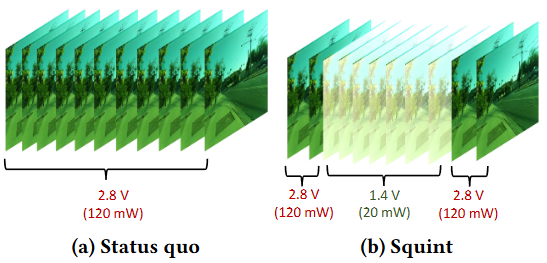
Comparison of fixed-voltage sensing with Squint's adaptive voltage scheduling
Figure 1. Instead of continuously imaging at a fixed, high voltage, Squint can reserve high-voltage capture for the moments when fidelity matters most.
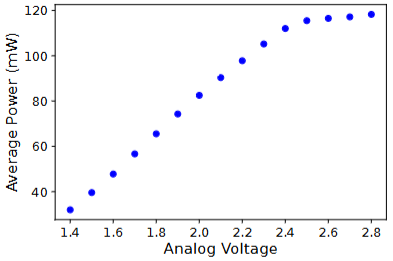
Chart showing average sensor power as analog voltage increases
Figure 2. Lower analog voltage reduces sensor power.
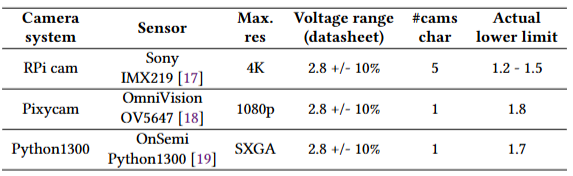
Table of characterized image sensors and voltage limits
Figure 3. Characterized image sensors and their practical voltage limits.

System Architecture: Voltage-Aware Visual Streaming

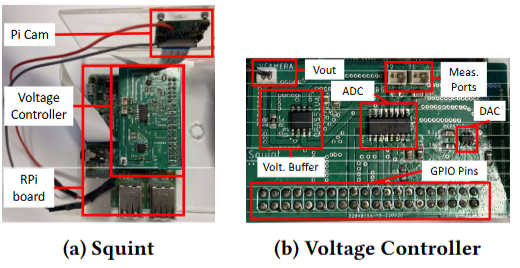
Squint characterizes the power and fidelity implications of analog voltage scaling across off-the-shelf sensors, then integrates a programmable voltage controller into an RPi-based streaming pipeline. Applications can request sensor-voltage changes on a frame-by-frame basis.
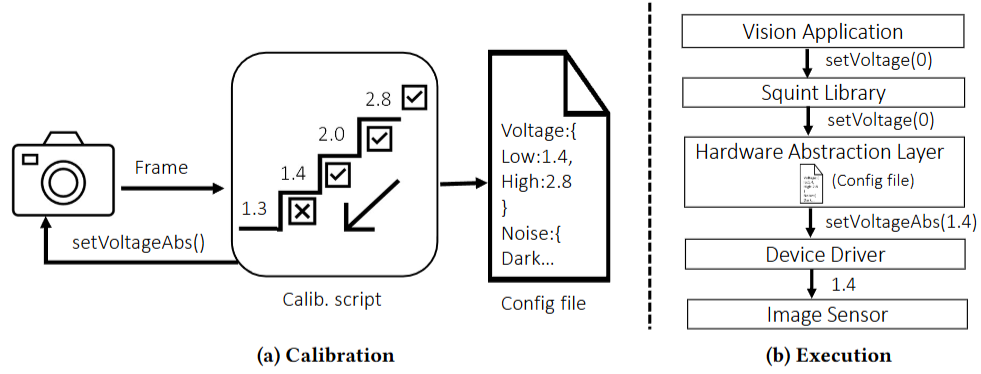
Squint calibration and execution workflow from vision application to image sensor
Figure 4. Squint calibrates feasible voltage ranges and exposes voltage control through the visual streaming stack.
Squint prototype with Raspberry Pi camera and voltage controller
Figure 5. The Squint prototype pairs an RPi camera with a programmable voltage controller.
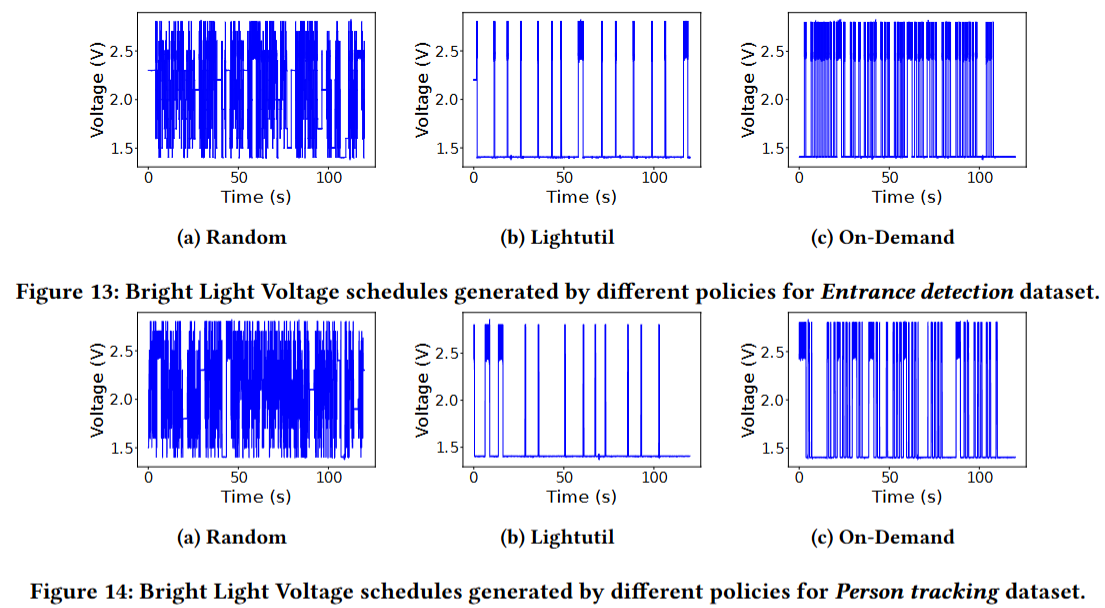
Voltage schedules generated by random, Lightutil, and on-demand policies
Figure 6. Different policies generate distinct voltage schedules for entrance detection and person tracking tasks.

Results: Lower Sensor Power for Vision Tasks

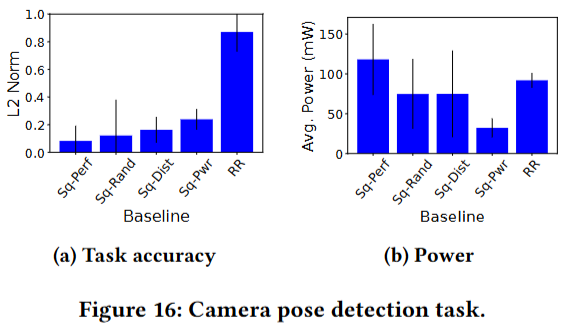
Across a range of voltage-scaling policies and popular vision tasks, Squint demonstrates sensor power savings of up to 73% while maintaining reasonable task fidelity.
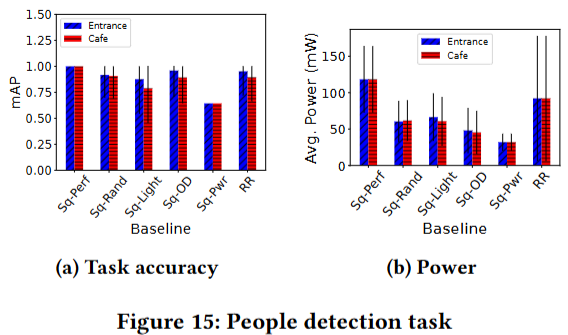
People-detection task accuracy and power results
Figure 7. People-detection accuracy and power across policies.
Camera pose-detection task accuracy and power results
Figure 8. Camera pose-detection accuracy and power across policies.
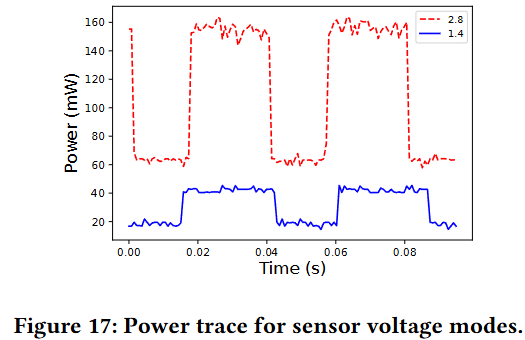
Power trace comparing sensor operation at 2.8 volts and 1.4 volts
Figure 9. Lower-voltage sensor operation substantially reduces the power trace.