
This mixed-reality titration lesson pairs a 3D-printed burette with a virtual chemistry experiment, testing how embodied, gesturally congruent interaction shapes learning.
Introduction: Bringing Laboratory Gestures Into Online Learning
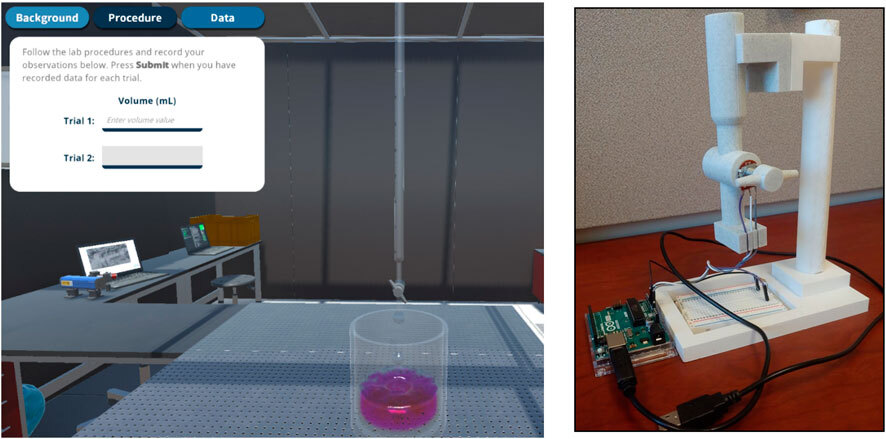
The project asks when a physical, gesturally congruent control benefits STEM learning. A 3D-printed burette connects the familiar turning of a stopcock to a virtual titration experiment, adding passive haptic feedback to the digital lesson.
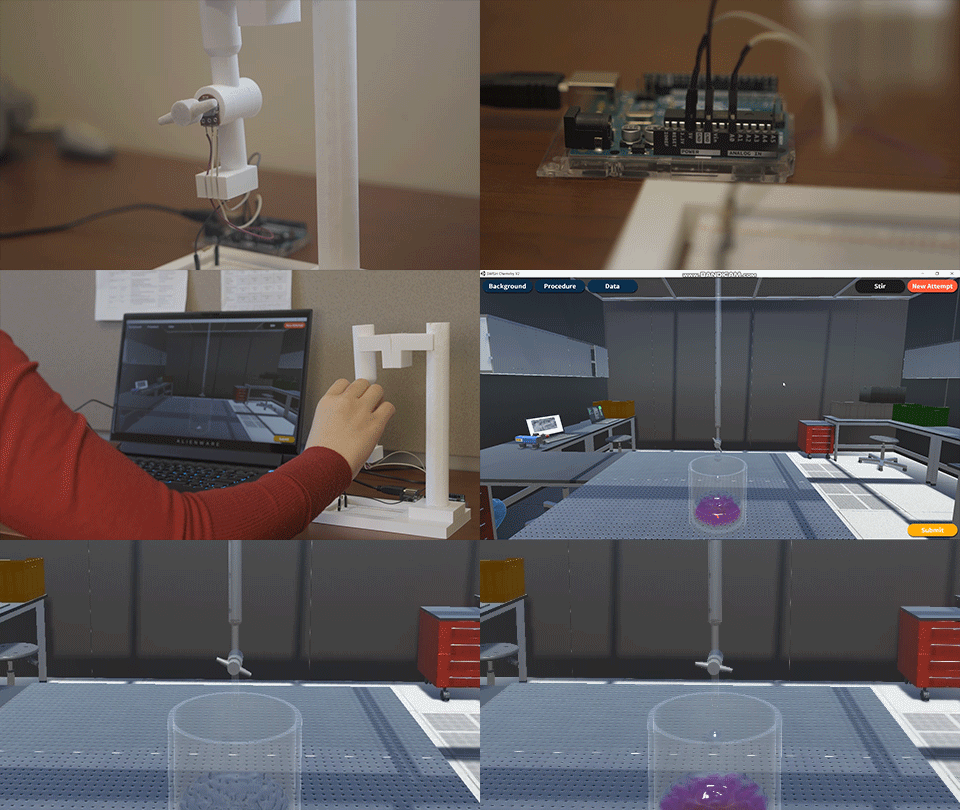
Study Design: Comparing Embodied and Keyboard Control
In a randomized study with 136 college students, learners either controlled the virtual stopcock with keyboard arrows or physically turned the valve of a 3D-printed burette. Both conditions used the same titration lesson and visual information.
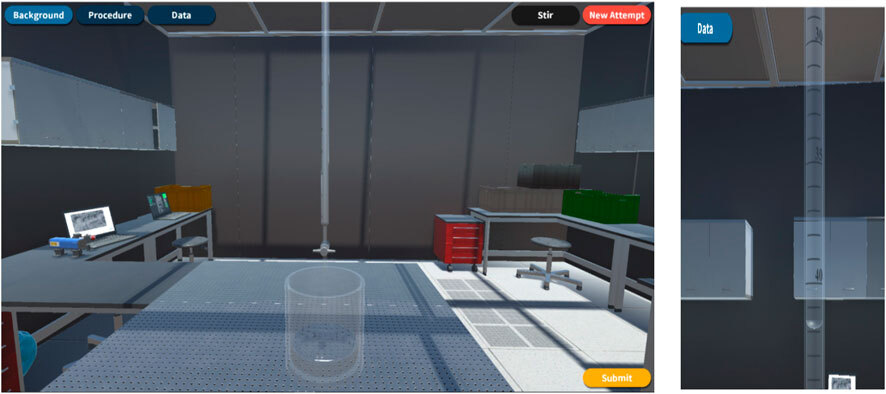
Results: Matching Interface Complexity to Learner Readiness
Both groups improved on declarative knowledge. Deeper analyses favored the embodied device for learners with higher prior science knowledge, while the results suggest that lower-prior-knowledge learners may benefit from beginning with the more familiar keyboard interface before transitioning to richer mixed-reality interaction.